

Blog
Type C vs Micro USB: Which One Wins in 2026?

Introduction
You’re rushing out the door, you grab your charging cable, plug it into your phone, and realize you’ve got the wrong one. Sound painfully familiar?
In Pakistan, where you’ll find everything from the latest Samsung Galaxy S25 to budget Android phones still running on Micro-USB ports, the type c vs micro usb debate is very much alive in 2026. Walk into any mobile accessories shop in Islamabad’s Melody Market or browse any online store, and you’ll see both cable types sitting side by side often with confusing labels and wildly different prices.
So which one should you actually be using? Which charges faster, lasts longer, and gives you better value for money?
In this guide, we’ll break down the type c vs micro usb comparison across every dimension that matters: charging speed, data transfer, durability, device compatibility, and real-world value for Pakistani users. We’ll also cover when a 5-in-1 charging cable makes more sense than buying two separate cables.
By the end, you’ll know exactly which cable to buy and why.
What Is Micro USB? (And Why It’s Still Around)
Micro-USB launched in 2007 and became the universal standard for Android phones, power banks, and accessories throughout the 2010s. If you owned any Android phone before 2019, you almost certainly used a Micro USB cable every single day.
Here’s what defines Micro-USB in 2026:
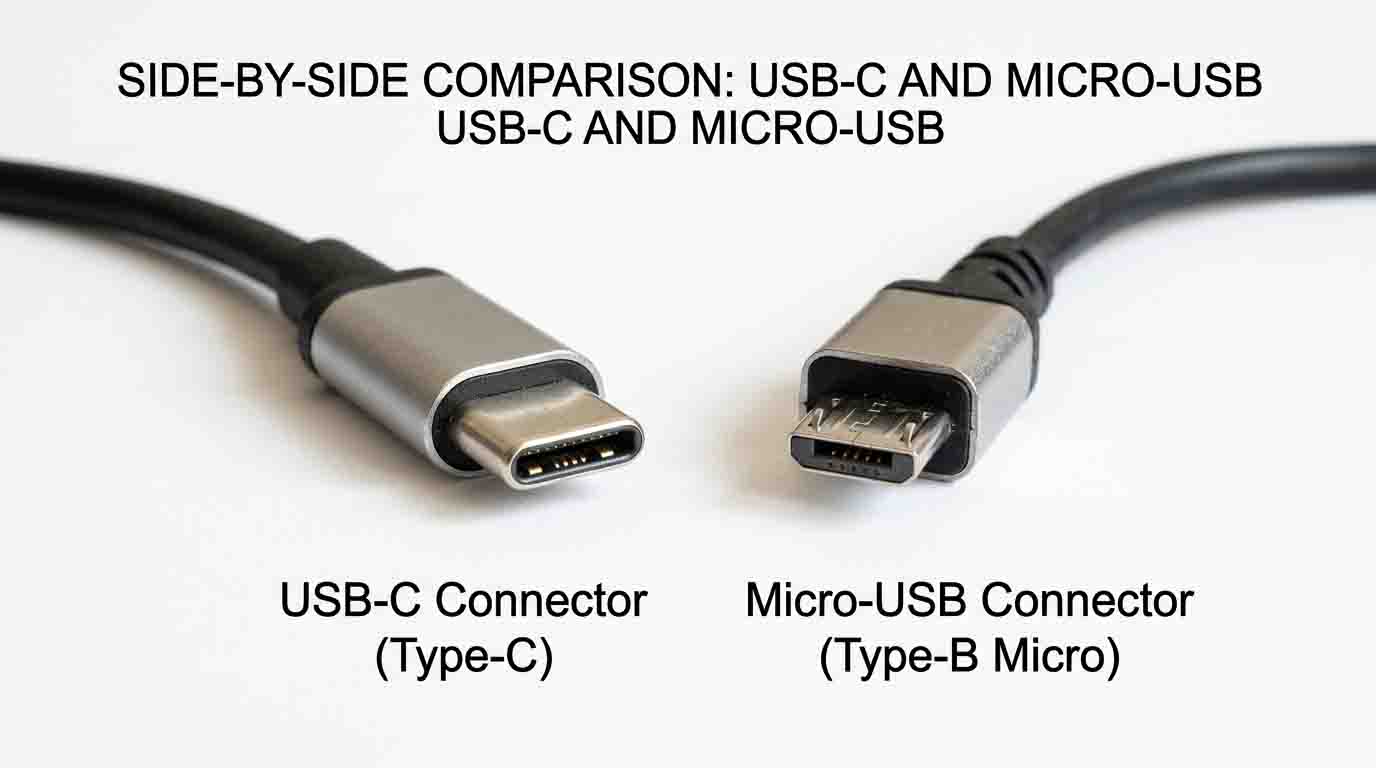
- Connector shape: Asymmetric, D-shaped must be inserted a specific way (and you’ll get it wrong the first two times, every time)
- Max charging speed: Up to 18W with Quick Charge 3.0; most standard setups deliver 5W–10W
- Max data speed: USB 2.0 up to 480 Mbps
- Durability: Rated for approximately 10,000 insertion cycles
Micro-USB isn’t dead yet in Pakistan. Many budget Android phones under PKR 20,000, wireless earbuds, portable speakers, and even some power bank models still use it. It’s also extremely cheap and widely available.
But its limitations are impossible to ignore in 2026, especially when fast charging has become standard even on mid-range phones.
What Is USB Type C? (The Modern Standard Explained)
USB Type C or simply Type C cable arrived as the new universal standard around 2015–2016, and by 2026, it has essentially taken over. From iPhones to laptops to earbuds to power banks, if it’s new, it almost certainly has a USB-C port.
Here’s what makes the type c cable different:
- Connector shape: Oval, fully reversible it goes in the right way every single time
- Max charging speed: Up to 240W (USB4 Gen 3 specification)
- Max data speed: Up to 40 Gbps (USB4 / Thunderbolt 4)
- Durability: Rated for approximately 10,000 insertion cycles (same as Micro-USB, but better contact design)
- Versatility: Carries power, data, video output, and audio signals over a single cable
The key difference isn’t just speed it’s capability. A single type c cable can charge your phone, transfer photos, output video to a monitor, and even power your laptop. Micro-USB simply cannot do any of that.
Type C vs Micro USB: Head-to-Head Comparison
Let’s put both standards side by side across every major category.
Charging Speed
| Feature | Micro USB | USB Type C |
| Standard charging | 5W | 5W–18W |
| Fast charging (max) | 18W (QC 3.0) | 240W (USB4) |
| Common real-world speed | 5W–10W | 25W–65W |
| Protocol support | Quick Charge 2.0/3.0 | USB-PD, QC 4.0/5.0, VOOC, SuperVOOC |
Winner: USB Type C by a wide margin.
A mid-range phone in Pakistan today with 33W fast charging will fully charge in about 65–70 minutes with the right fast charging cable. The same battery on Micro-USB would take over 2 hours.
Data Transfer Speed
| Standard | Micro USB | USB Type C |
| USB 2.0 | 480 Mbps | 480 Mbps |
| USB 3.2 Gen 1 | Not supported | 5 Gbps |
| USB 3.2 Gen 2 | Not supported | 10 Gbps |
| USB4 | Not supported | 40 Gbps |
If you transfer large video files, back up photos, or use your phone as external storage, a Type-C cable isn’t just faster it’s in a completely different league.
Winner: USB Type C.
Durability & Build
Both connector types are officially rated for ~10,000 insertions. In real life, however, the type C cable connector tends to hold up better because:
- The oval, symmetrical design distributes stress more evenly
- No forced directional insertion means less port damage over time
- The slightly larger pin contact area improves long-term conductivity
Micro-USB’s narrow design and directional insertion mean the connector loosens faster with heavy daily use, a common complaint among mobile repair technicians in Islamabad and across Pakistan.
Winner: USB Type C.
Reversibility & Convenience
This might sound minor, but ask anyone who’s ever fumbled with a Micro-USB cable in a dark room. Micro-USB has a defined top and bottom get it wrong and you risk bending the pins over time.
USB-C is fully reversible. Either orientation works. It just clicks in cleanly, every time.
Winner: USB Type C.
Device Compatibility in Pakistan (2026)
| Device Type | Micro USB | USB Type C |
| Budget Android (under PKR 20K) | Common | Increasingly common |
| Mid-range Android (PKR 20K–60K) | Rare | Standard |
| Flagship Android (PKR 60K+) | Gone | Universal |
| iPhone 15 and above | ❌ | ✅ |
| Laptops & tablets | ❌ | ✅ |
| Power banks (new models) | Output port only | Full support |
| Wireless earbuds | Still common | Rapidly replacing |
Winner: USB Type C for future-proofing. Micro-USB for legacy compatibility only.
Price & Availability in Pakistan
This is where Micro-USB still holds ground. In Islamabad’s electronics markets and small mobile shops across Pakistan:
- Micro-USB cables: PKR 100–500 (basic to decent quality)
- Type C cables (standard): PKR 200–800
- Type C fast charging cables (certified): PKR 500–2,000+
The gap is shrinking fast. As USB-C becomes the default, supply has increased, and prices have dropped. In 2026, a good fast charging cable in Type C format is no longer expensive, it will be accessible.
Winner: Micro USB on price for now. Closing fast.
When Does Micro USB Still Make Sense?
Let’s be fair. Micro-USB isn’t useless in 2026. Here’s when it still makes practical sense:
- Your current phone still uses Micro-USB, and you’re not upgrading soon
- Your power bank’s input port is Micro-USB (many older and budget models in Pakistan still are)
- Specific accessories — some headphones, speakers, and IoT devices still use Micro-USB
- Budget is extremely tight — a PKR 150 Micro-USB cable keeps older devices charged
If any of the above applies, a Micro-USB cable absolutely does the job. Just don’t expect fast charging speeds and start planning your upgrade.
What Is a 5-in-1 Charging Cable, and Should You Get One?
If you’re juggling multiple devices with different ports, maybe an iPhone 15 (USB-C), an older Android on Micro-USB, and a pair of wireless earbuds, a 5-in-1 charging cable is a genuinely practical solution.
A typical 5-in-1 charging cable includes:
- USB-C connector
- Micro-USB connector
- Lightning connector (for older iPhones / AirPods)
- Sometimes a second USB-C (for laptops)
- USB-A plug on the other end for wall adapters or power banks
Who Should Buy a 5-in-1 Charging Cable?
- Families: One cable handles every family member’s devices
- Travelers: Reduces the number of cables in your bag — crucial for carrying essentials
- Offices: One shared cable at a desk works for any visitor’s device
- Tech users in Pakistan with a mix of old and new devices
What to Watch Out For
Not all 5-in-1 charging cable products support fast charging across all connectors. Many budget versions max out at 2.4A (about 12W) across all connectors. If you need fast charging, look specifically for one that states USB-PD or Quick Charge support on the USB-C connector.
Browse the certified selection of multi-connector cables at Connect5.pk’s accessories collection to find options that balance versatility with real charging performance.
6 Expert Tips for Choosing Between Type C and Micro USB in 2026
1. Always Lead With Your Newest Device
If your primary smartphone is 2021 or newer, it almost certainly has USB-C. Buy a quality Type-C cable as your main cable and only keep Micro-USB for legacy accessories.
2. Don’t Buy Micro USB for a New Phone
Even if a new phone under PKR 20,000 still ships with Micro-USB, check whether the manufacturer plans to continue that line. Many budget brands have already transitioned to USB-C across their entire 2025–2026 lineup.
3. Prioritize E-Marker Chips for High-Watt Cables
Any fast charging cable rated above 60W needs an embedded E-Marker chip to safely negotiate high-wattage charging. This is exclusive to USB-C, another reason the Type-C vs. Micro USB debate is increasingly one-sided at the performance end.
4. Get a 5-in-1 Charging Cable for Travel
Heading out of Islamabad for a trip? One 5-in-1 charging cable eliminates cable clutter and covers you for any device emergency. Read our full guide on which charging cable charges fastest in 2026 for help picking the right multi-cable for your setup.
5. Check Your Power Bank’s Ports
Many Pakistanis use power banks daily — especially given load-shedding. If your power bank has both USB-A and USB-C outputs, always use the USB-C output with a quality Type-C cable for faster charging. For help choosing the right power bank altogether, read our guide on how to choose the best power bank.
6. If Your Phone Isn’t Charging Properly, the cable is often the reason
Before blaming your charger or phone port, try swapping the charging cable. A degraded or incompatible USB cable is the most common culprit behind slow or failed charging. Get a full diagnostic checklist from our guide on why your phone might not be charging.
FAQ — Type C vs Micro USB Questions Answered
Q1: Is USB Type-C better than Micro USB?
A: Yes, in almost every measurable way. Type C vs Micro USB — Type C wins on charging speed, data transfer, reversibility, and future compatibility. Micro-USB is only relevant for older or budget devices in 2026.
Q2: Can I use a Type C cable to charge a Micro USB device?
A: Not directly. The physical connectors are different and incompatible without an adapter. You can buy a USB-C to Micro-USB adapter, but it’s simpler to just keep a separate usb cable for your Micro-USB device.
Q3: Does a fast charging cable work with any phone?
A: A fast charging cable works at fast speeds only when both the charger and the phone support the same fast-charge protocol (USB-PD, Quick Charge, etc.). The cable must also be rated for the required wattage. Using a fast cable with a standard 5W charger will still only charge at 5W.
Q4: What is a 5-in-1 charging cable?
A: 5-in-1 charging cable is a multi-connector cable that includes USB-C, Micro-USB, Lightning, and sometimes additional connectors in a single cable. It’s ideal for users with multiple devices or mixed-generation tech. Quality varies significantly — prioritize ones with USB-PD support on the USB-C end.
Q5: Which cable type is more common in Pakistan in 2026?
A: USB-C has overtaken Micro-USB in new device sales across Pakistan as of 2025–2026. However, Micro-USB is still widely used in older devices, accessories, and budget-tier products. Both USB cable types are readily available in markets like Islamabad’s Melody Market and online via local stores.
Q6: Will Micro USB become obsolete soon?
A: Effectively, yes. The European Union’s common charger regulation mandated USB-C for all new devices sold in Europe from 2024, which has accelerated the global shift. Micro-USB will persist in accessories and legacy devices for a few more years, but is no longer a standard for new smartphones.
Q7: Is a Type C cable safe for budget phones in Pakistan?
A: Yes, a certified Type-C cable is safe for any USB-C device, regardless of price range. The cable simply won’t trigger fast charging if the phone’s chip doesn’t support it. There is no risk to the device from using a higher-rated cable on a lower-spec phone.
Conclusion
The Type C vs. Micro USB debate has a clear winner in 2026: USB Type C wins on every performance metric — charging speed, data transfer, durability, and future compatibility. If you’re still using Micro-USB cables for a new device, you’re leaving real charging speed on the table.
That said, Micro-USB still serves a purpose for older accessories and budget devices — and a well-made 5-in-1 charging cable can bridge the gap if you’re managing a mix of old and new devices in your home or office.
The bottom line: invest in at least one quality fast charging cable in USB-C format, keep a Micro-USB option for legacy needs, and always buy certified especially if you’re in Islamabad or anywhere in Pakistan where power fluctuations can stress cheap cables.
Ready to upgrade? Explore Connect5.pk’s full range of certified charging cables and accessories built for Pakistan’s devices, climate, and power realities.
Still confused about which cable fits your phone? Drop your device model in the comments and we’ll help you pick the right one.


