Blog
How to Choose a Power Bank: 7 Smart Tips Before You Buy (2026 Guide)

Introduction
You’re out in Islamabad, stuck in traffic on Murree Road, your phone hits 4%, and your power bank is sitting on your desk at home. Sound familiar?
We’ve all been there. But here’s the bigger problem: most people who own a power bank bought the wrong one. Either it runs out too fast, charges too slowly, or dies within six months. That’s not a power bank problem, that’s a buying decision problem.
Knowing how to choose a power bank the right way can mean the difference between a device that saves your day and one that wastes your money. In this guide, we’ll walk you through 7 practical, expert-backed tips from understanding power bank capacity to decoding fast charging specs so you can make a confident, informed purchase in 2026.
Whether you’re a student in Lahore, a professional commuting in Karachi, or a traveler passing through Islamabad, this guide is for you.
Here’s what we’ll cover:
- Capacity: How many mAh do you actually need?
- Charging speed and output specs
- Number of ports and device compatibility
- Size, weight, and portability
- Build quality and safety certifications
- Brand reliability in Pakistan
- Price vs. value: Where to spend wisely
Let’s dive in.
1. Start with Capacity: The Most Important Number
The first thing most people look at is the mAh (milliampere-hour) number on the box. And honestly? It is the most important number, but only if you understand what it means for your specific needs.
What Does mAh Actually Tell You?
mAh is the measure of how much energy a power bank can store. The higher the number, the more charges you get. But here’s what most sellers won’t tell you: real-world efficiency is typically 65–80% of rated capacity due to heat loss, voltage conversion, and cable resistance.
So a 10,000mAh power bank won’t fully charge a 5,000mAh phone battery twice. You’ll realistically get about 1.5 full charges.
Quick Capacity Reference Guide
| Device | Battery Size | Charges from 10,000mAh |
| Standard smartphone | 4,000–5,000mAh | 1.5 – 2x |
| Large phone / iPhone Pro Max | 4,400–4,700mAh | 1.5x |
| Tablet (e.g., iPad) | 8,000–10,000mAh | ~0.8x |
| TWS Earbuds | 500–800mAh | 8–10x |
| Smartwatch | 300–500mAh | 12–15x |
Which Capacity Should You Pick?
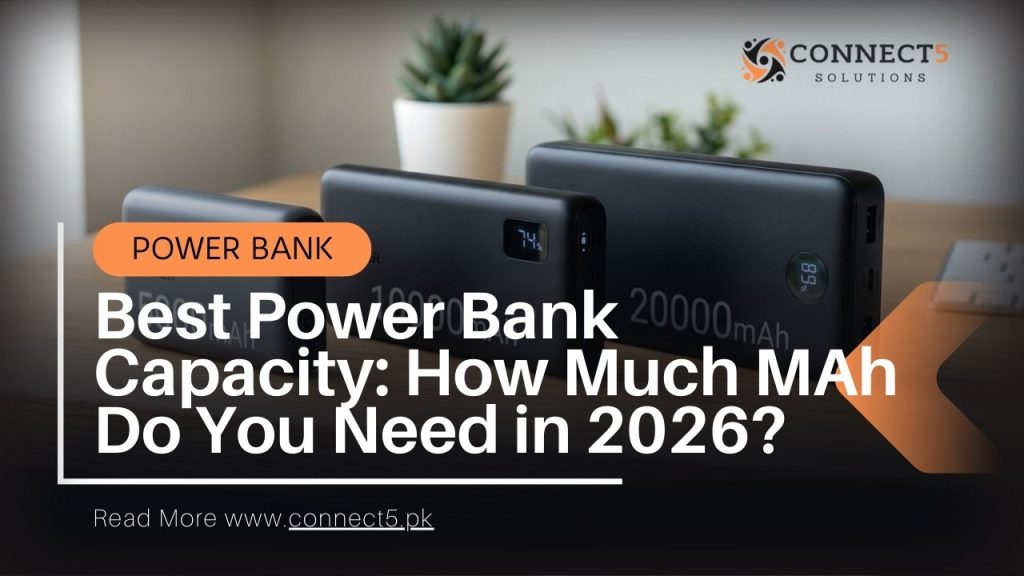
- 5,000mAh Ultra-portable, slim design, fits in a jeans pocket. Ideal for a half-day top-up. If you’re curious whether a 5,000mAh power bank matches your daily usage, the answer is: it works for light users with one device.
- 10,000mAh is the sweet spot for most people. One full charge for a phone, plus some left over.
- 20,000mAh Best for heavy users, travelers, or anyone charging multiple devices. Check out the Ronin 20,000mAh power bank if you need serious backup capacity.
- 30,000mAh+ Mostly for tablets, laptops, or group travel.
Pro Tip for Pakistan Users: Load-shedding is still a reality in many cities. A 20,000mAh power bank doubles as an emergency home backup for your phone during outages, something worth considering.
2. Don’t ignore charging speed input and output; both matter.
Most buyers focus only on capacity. The smarter ones also check charging speed, and that means understanding two separate ratings:
Output Speed: How Fast Does It Charge Your Device?
Output is measured in watts (W). Higher watts = faster charging for your phone.
- 5W (1A): Slow. Standard for budget power banks. Fine for overnight charging.
- 10–12W (2A): Decent. Most mid-range power banks operate here.
- 18W (Quick Charge 3.0): Fast charging for compatible Android devices.
- 20W+ (PD — Power Delivery): Fast charging for iPhones, Samsung, and more.
- 45W / 65W PD: Can fast-charge laptops. Premium tier only.
Check your phone’s maximum charging wattage before buying. If your phone supports 25W fast charging but your power bank only outputs 10W, you’re leaving speed on the table.
Input Speed: How Fast Does the Power Bank Itself Recharge?
This is often overlooked. A 20,000mAh power bank with only 5W input charging will take 12–15 hours to recharge itself. That’s almost useless.
Look for at least 18W input, or better yet, 20W+ PD input, so your power bank is ready again within 3–5 hours.
USB-C PD vs. Quick Charge: Which Is Better?
| Feature | USB-C Power Delivery | Qualcomm Quick Charge |
| Compatibility | Universal (iPhones, Android, laptops) | Mainly Android |
| Max Speed | Up to 100W+ | Up to 45W |
| Future-proof | Yes | Partially |
| Port type | USB-C | USB-A or USB-C |
Bottom line: For 2026, choose a power bank with USB-C PD support for maximum compatibility.
3. Count Your Ports, One Is Never Enough
If you carry more than one device (and most of us do), a single-port power bank becomes a compromise. You’re forced to choose which device to charge first.
What to Look For
- Minimum 2 output ports for everyday use
- At least one USB-C port (for modern smartphones, earbuds, and laptops)
- USB-A ports for older cables or accessories
- Some models offer wireless charging, which is convenient but adds cost and bulk
Port Combinations That Make Sense in 2026
The ideal setup for most Pakistani users:
- 1x USB-C (PD output + input)
- 1x USB-A (standard or QC)
- Optional: 1x Micro-USB input (legacy support)
Brands like Anker offer excellent multi-port configurations without massive price hikes. See how Anker compares to Mi power banks for port variety and build quality.
4. Size and Weight Match It to Your Lifestyle
Here’s a truth nobody says clearly: the best power bank is the one you actually carry.
A 20,000mAh beast sitting in your backpack does nothing if you left it at home because it was too heavy.
Size vs. Capacity Trade-off
| Capacity | Typical Weight | Fits In |
| 5,000mAh | 100–130g | Jeans pocket |
| 10,000mAh | 180–220g | Jacket pocket / small bag |
| 20,000mAh | 320–450g | Backpack or handbag |
| 30,000mAh+ | 550g+ | Travel bag only |
Who Should Choose What?
- Daily commuters in Islamabad or Karachi: 10,000mAh is ideal, light enough to carry, powerful enough for a full charge.
- Students: 10,000mAh or 20,000mAh, depending on how long you’re on campus.
- Frequent flyers or road trippers: 20,000mAh. Also note that airlines typically allow power banks up to 27,000mAh (100Wh) in carry-on luggage only.
- Minimalists: A slim 5,000mAh fits perfectly in a shirt pocket for quick top-ups.
5. Build Quality & Safety Certifications Non-Negotiable
Pakistan’s market is flooded with uncertified, low-quality power banks that look impressive on paper. Some have caused fires, battery bloating, and device damage. This is not an exaggeration.
What Safety Features to Look For
- Li-Polymer batteries (safer, lighter, don’t bloat as easily as Li-Ion in cheap units)
- Overcharge protection stops charging when full
- Over-discharge protection preserves battery health
- Short-circuit protection critical for device safety
- Temperature control prevents overheating
- CE, FCC, or RoHS certification: Look for these on the box or product page
How to Spot a Fake or Low-Quality Power Bank
- Price seems too good to be true (Rs. 500 for 20,000mAh? Red flag.)
- No brand name or unclear origin
- No safety certification logos
- Capacity doesn’t match actual performance
- Gets very hot during use
Stick to trusted brands with a real Pakistani warranty and support — and avoid no-name products from unverified sellers, no matter how attractive the deal looks.
6. Brand Reliability Who to Trust in Pakistan (2026)
When you’re spending Rs. 2,000 to Rs. 8,000+ on a power bank, brand matters. Here’s a quick breakdown of the major players available in Pakistan right now:
Top Power Bank Brands in Pakistan
| Brand | Known For | Best For |
| Anker | Premium build, fast charging | iPhone users, professionals |
| Mi (Xiaomi) | Value for money | Budget-conscious buyers |
| Ronin | High capacity, local availability | Heavy users, travel |
| Baseus | Stylish, feature-rich | Tech enthusiasts |
| Ambrane | Budget segment | Students |
For a deep comparison of the two most popular choices, read the full Anker vs Mi power bank breakdown — it covers specs, pricing, and who each brand is best for in Pakistan.
You can also explore the top power banks in Pakistan for 2026 for a comprehensive ranked list across all budgets.
7. Price vs. Value: Where to Spend and Where to Save
Let’s be honest, budget matters. Here’s how to think about price tiers when choosing a power bank in Pakistan:
Power Bank Price Tiers (Pakistan 2026)
| Budget | Expected Specs | What You Get |
| Under Rs. 1,500 | 5,000–10,000mAh, 5–10W | Basic charging, no fast charge |
| Rs. 1,500–3,000 | 10,000mAh, 18W QC | Solid daily driver |
| Rs. 3,000–5,000 | 10,000–20,000mAh, 20W PD | Fast charge, multi-port |
| Rs. 5,000–8,000+ | 20,000mAh+, 45–65W PD | Laptop charging, premium build |
Where NOT to Compromise
- Safety certifications always worth the extra cost
- Input charging speed, slow recharge kills daily usability
- Brand warranty, local after-sales support matters
Where You Can Save
- You don’t need wireless charging unless it’s genuinely convenient for you
- LED displays are nice, but not essential
- Brand prestige — mid-tier brands often offer 90% of the performance at 60% of the price
7 Expert Tips Summary: How to Choose a Power Bank the Smart Way
Here’s a quick-reference checklist before you buy:
- Calculate your real mAh need — multiply your phone battery by 1.5 for one full real-world charge
- Check output wattage — match it to your phone’s max charging speed
- Verify input speed — aim for 18W+ so it recharges overnight easily
- Choose USB-C PD for future-proof compatibility
- Pick 2+ ports if you carry multiple devices
- Verify safety certifications — CE, FCC, or RoHS on the box
- Buy from a reliable brand with local warranty support in Pakistan
Common Mistakes People Make When Buying a Power Bank
Mistake 1: Only Comparing mAh Numbers
Two 20,000mAh power banks can deliver very different real-world performance based on efficiency, battery type, and voltage output. Always check actual reviews alongside specs.
Mistake 2: Ignoring the Recharge Time
A power bank you can’t recharge overnight is a daily headache. Always check input wattage.
Mistake 3: Buying Without Checking Device Compatibility
Some fast-charge protocols only work with specific devices. Qualcomm Quick Charge won’t fast-charge iPhones. USB-C PD works with almost everything.
Mistake 4: Trusting Unverified Pakistani Sellers for Cheap Prices
Counterfeit power banks are common in local markets. Always buy from verified stores or official brand distributors.
Mistake 5: Buying Too Small “To Save Weight”
If you run out of charge before the day ends, the power bank failed its job. Better to carry 50g more than to run out of battery.
FAQs: How to Choose a Power Bank
Q1. How do I know what capacity power bank I need?
A simple rule: multiply your phone’s battery size (in mAh) by 1.5 to get one real full charge. For two full charges, multiply by 3. Most people are fine with 10,000mAh for daily use.
Q2. Is a 5,000mAh power bank enough for a full day?
For light users with a single phone, yes — a 5,000mAh power bank can provide roughly one full charge for most smartphones. For heavier usage or larger phones, go for 10,000mAh.
Q3. What does “PD” mean on a power bank?
PD stands for Power Delivery — a USB-C fast-charging standard. It supports higher wattages (20W, 45W, 65W+) and works with a wide range of devices, including iPhones, Android phones, and laptops.
Q4. Can I take a 20,000mAh power bank on a flight from Islamabad?
Generally, yes — most airlines allow power banks up to 100Wh (roughly 27,000mAh at 3.7V) in carry-on baggage only. Always check your specific airline’s policy before travel.
Q5. Which is better, Anker or Mi power bank in Pakistan?
Both are solid choices. Anker typically offers better build quality and after-sales support. Mi offers more value per rupee. Your best choice depends on budget and use case — read the full Anker vs Mi comparison for a detailed verdict.
Q6. Why does my power bank die faster than expected?
Batteries degrade over charge cycles. Heat exposure (common in Pakistani summers), cheap battery cells, and overcharging all accelerate degradation. Quality brands using Li-Polymer cells last significantly longer.
Q7. Should I buy a wireless charging power bank?
Only if you use wireless charging regularly and don’t mind the extra weight and cost. Wireless charging is less efficient (~30–40% slower) and generates more heat than wired charging.
Conclusion
Knowing how to choose a power bank isn’t complicated — but it does require more than just picking the highest mAh number on the shelf.
The right power bank for you depends on your device, your daily usage, your lifestyle, and your budget. By focusing on the 7 factors we’ve covered — capacity, charging speed, port count, portability, build quality, brand trust, and price — you’ll avoid the mistakes most buyers make and end up with a device that genuinely serves you.
For Pakistani buyers in 2026, the market has never been better — from budget-friendly options to premium fast-charging beasts — but so has the number of low-quality fakes. Shop smart, stick to verified brands, and always check those safety certifications.
Ready to find your perfect match? Browse the top power banks available in Pakistan for 2026 — handpicked and reviewed for quality, value, and performance. Whether you’re in Islamabad, Lahore, or Karachi, connect5.pk has options across every budget.
Still unsure which one is right for you? Drop your question in the comments or reach out — we’re happy to help you choose.