Blog
Power Bank Capacity Explained: Find Your Perfect mAh Match in Pakistan (2026)

Introduction
You bought a power bank six months ago. It seemed big enough at the time. But lately, it dies before your phone does, and you’re back to hunting for a wall socket at every café in Islamabad.
Sound familiar? You’re not alone. Choosing the wrong power bank capacity is one of the most common and most frustrating mistakes Pakistani buyers make. because they didn’t research, but because nobody explained what those mAh numbers actually mean for their specific devices and daily habits.
Power bank capacity is the single most important spec to get right before you buy. Get it right, and you’ve got reliable backup power for months. Get it wrong, and you’re either carrying dead weight or running out of charge at the worst possible moment.
In this guide, we’ll decode mAh once and for all, walk you through every capacity tier available in Pakistan, and help you figure out exactly which size fits your life — whether you’re a student in Islamabad, a traveling professional, or someone who just wants the phone to survive the day.
Here’s what’s covered:
- What mAh actually means in real-world terms
- Capacity tiers from 5,000mAh to 30,000mAh explained
- Which capacity suits which type of user
- How Pakistani conditions affect your choice
- Expert tips and FAQs to seal the deal
What Does Power Bank Capacity (mAh) Actually Mean?
Let’s start with the basics because most product listings use mAh without ever explaining it properly.
mAh stands for milliampere-hour. It’s a unit that measures how much electrical charge a battery can store and deliver over time. Think of it like a water tank. A larger mAh rating means a bigger tank.
But here’s the catch: you never get 100% of that stored energy delivered to your device.
Why Real-World Capacity Is Lower Than Rated
When a power bank transfers energy to your phone, some is lost as:
- Heat during energy conversion
- Voltage step-up loss (power banks store at ~3.7V but output at 5V)
- Cable and connector resistance
The result? Real-world efficiency typically runs at 65–80% of the rated capacity. This is true for every brand, including premium ones.
The Simple Formula to Calculate Real Charges
Usable energy = Rated mAh × 0.7 (average efficiency) Charges = Usable energy ÷ Device battery size
Example: A 10,000mAh power bank charging a phone with a 5,000mAh battery:
- Usable energy: 10,000 × 0.7 = 7,000mAh
- Charges: 7,000 ÷ 5,000 = ~1.4 full charges
Not two full charges, as most people assume — closer to one and a half. Keep this formula in mind as we go through the capacity tiers below.
Power Bank Capacity Tiers: Which One Is Right for You?
Pakistan’s market in 2026 offers power banks across a wide range of capacities. Here’s a clear breakdown of each tier, what it delivers, and who it suits best.
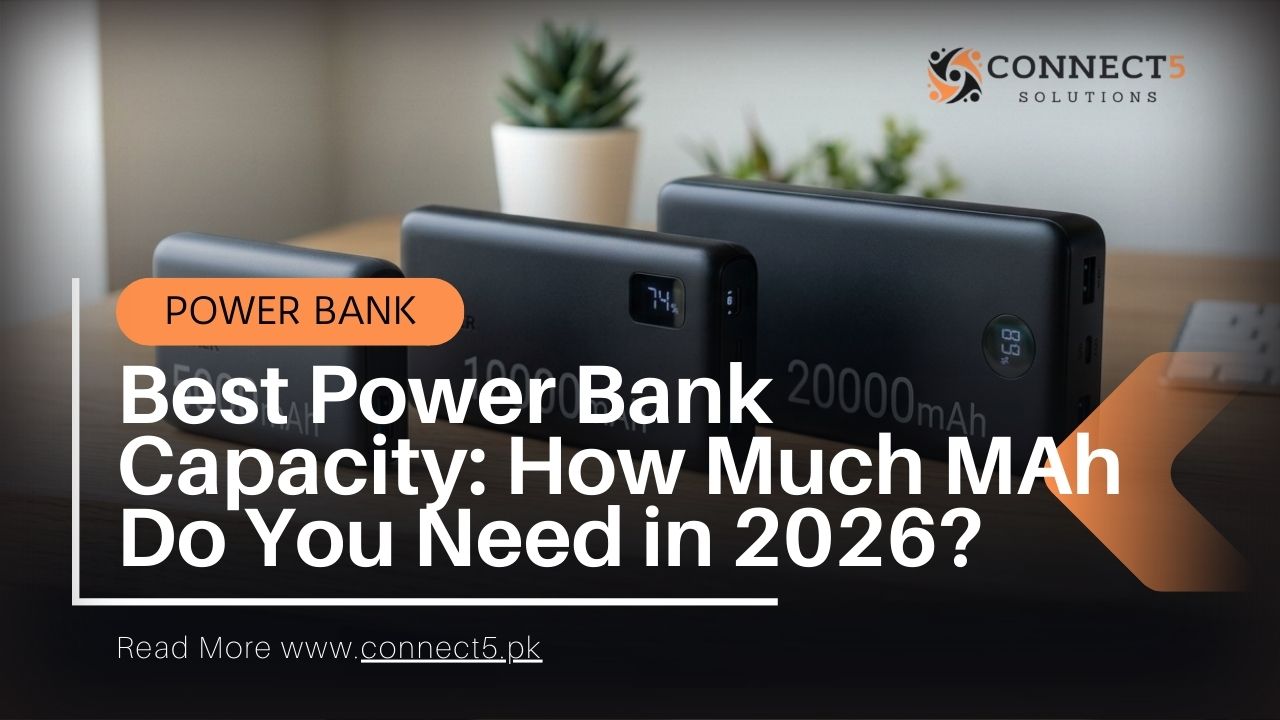
5,000mAh The Pocket-Friendly Top-Up
Real usable charge: ~3,500mAh Typical weight: 100–130g Fits in: Jeans pocket
| Charges | Device |
| ~1 full charge | Smartphones (4,000–5,000mAh) |
| ~4–5x | TWS Earbuds |
| ~6–8x | Smartwatch |
Best for: Students, light phone users, and people who want something slim and pocketable for quick top-ups during the day.
Not ideal for: Anyone who uses navigation, streaming, or video calls heavily, or who needs more than one full charge per outing.
Curious about pricing? We’ve put together a complete breakdown of 5000mAh power bank prices in Pakistan, so you know exactly what to expect in 2026.
10,000mAh — The Sweet Spot for Most People
Real usable charge: ~7,000mAh Typical weight: 180–220g Fits in: Jacket pocket or small bag
| Charges | Device |
| ~1.5x full charges | Smartphones (4,000–5,000mAh) |
| ~8–10x | TWS Earbuds |
| ~0.7x | iPad / Tablet |
Best for: Daily commuters in Islamabad and other cities, professionals, and students who carry a bag and want a reliable all-day backup.
This is the single most popular power bank capacity in Pakistan — and for good reason. It balances portability with genuine usefulness across a full day.
20,000mAh — The Heavy Hitter
Real usable charge: ~14,000mAh Typical weight: 320–450g Fits in: Backpack or handbag
| Charges | Device |
| ~2.8x full charges | Smartphones |
| ~1.2x | iPad-sized tablet |
| ~0.3–0.5x | Laptop (with PD 45W+) |
Best for: Travelers, frequent flyers, load-shedding backup, field workers, and anyone charging multiple devices per day.
The Ronin 20,000mAh power bank is one of the most popular choices in this tier across Pakistan — well-reviewed, locally available, and priced competitively.
25,000–30,000mAh The Powerhouse
Real usable charge: ~17,500–21,000mAh Typical weight: 500–600g+ Fits in: Travel bag only
Best for laptop charging, group travel, or extended field use where wall outlets simply aren’t available for 24+ hours.
Note on air travel: IATA guidelines permit carry-on power banks up to 100Wh. A 27,000mAh unit at 3.7V equals exactly 100Wh — so go beyond that and you can’t fly with it.
How Pakistani Conditions Change Your Capacity Needs
Here’s something most international buying guides never mention and it matters a lot if you’re in Pakistan.
Load-Shedding Reality
In cities like Islamabad, Lahore, Peshawar, and many smaller towns, load-shedding can mean 4–12 hours without electricity on some days. A 10,000mAh power bank that’s “enough for a day out” suddenly isn’t enough when you also need it as a home backup for your phone during outages.
Recommendation for areas with moderate to heavy load-shedding: Go one tier up from what you’d otherwise choose. If a 10,000mAh battery would normally suit you, consider 20,000mAh.
Summer Heat and Battery Performance
Pakistan’s summer temperatures — regularly hitting 40–45°C in cities like Multan, Lahore, and even Islamabad — affect lithium battery performance significantly. Heat accelerates capacity degradation, meaning a power bank that performed at 75% efficiency in winter may drop to 60–65% efficiency during summer months.
This is another reason to buy slightly more capacity than you think you need, and to always store your power bank in the shade or a bag — never on a hot car dashboard.
Usage Patterns That Demand More
Pakistani smartphone users tend to run data-heavy apps — WhatsApp, YouTube, TikTok — and frequently use mobile data rather than Wi-Fi. Heavy data usage drains phone batteries faster, meaning your effective daily battery needs are often higher than those of users in countries with stable WiFi infrastructure.
Matching Capacity to User Type Quick Reference Guide
Not everyone needs to do the math. Here’s a simple map:
| User Type | Recommended Capacity | Why |
| Student (Islamabad campus) | 10,000mAh | All-day cover, fits in bag |
| Office commuter | 10,000mAh | One reliable recharge mid-day |
| Frequent traveler/flyer | 20,000mAh | Multi-day cover, flight-safe |
| Field worker / outdoor use | 20,000mAh | Rugged, high demand |
| Minimalist/light user | 5,000mAh | Pocket-sized top-up only |
| Family/group travel | 20,000–30,000mAh | Multiple devices, extended trips |
| Laptop user on the go | 20,000mAh+ with 45W PD | Enough wattage to charge laptops |
How Capacity Connects to Other Key Specs
Choosing the right power bank capacity is step one. But capacity doesn’t work in isolation — it connects directly to other specs that affect your experience.
Capacity + Output Speed
A 20,000mAh power bank with only 5W output will take forever to charge your phone. Meanwhile, a 10,000mAh bank with 20W PD will charge your phone as fast as your wall adapter.
Don’t let a big capacity number distract you from low output wattage.
Capacity + Input Speed (Recharge Time)
| Capacity | With 5W Input | With 18W+ Input |
| 5,000mAh | ~2.5 hours | ~1 hour |
| 10,000mAh | ~5 hours | ~2 hours |
| 20,000mAh | ~10–12 hours | ~4–5 hours |
A 20,000mAh power bank with 5W input will take half a day to recharge itself — a serious daily inconvenience. Always verify input wattage.
Capacity + Airline Rules
As mentioned above, the 100Wh limit means anything over ~27,000mAh at 3.7V cannot be carried onto a flight. If you travel frequently, stick to 20,000mAh or below.
For a complete guide on what else to check before buying — beyond just capacity — read our full breakdown on how to choose a power bank, covering every spec that matters.
7 Expert Tips for Choosing the Right Power Bank Capacity
- Use the 1.5x rule — multiply your phone’s battery size by 1.5 to find the minimum useful capacity for one full charge. Example: 5,000mAh phone × 1.5 = 7,500mAh needed.
- Add one tier for Pakistan conditions — load-shedding and heat mean you’ll likely use your power bank more than expected. Err on the side of more.
- Consider your longest away-from-outlet stretch — not your average day, your worst day. That’s what your power bank needs to handle.
- Check real-world reviews from Pakistani users — not global specs. Local summer heat and usage patterns affect performance differently.
- Don’t just look at mAh — check output wattage too — a 20,000mAh bank with 10W output is slower to charge your phone than a 10,000mAh with 20W PD.
- If you travel by air, stay at or below 20,000mAh to keep well within IATA carry-on limits without worrying at check-in.
- Match capacity to your primary use case — if 90% of your use is topping up a single phone, a 10,000mAh is smarter than a heavy 20,000mAh. Don’t over-buy if you won’t use it.
For more purchasing advice across all categories, explore the top power banks in Pakistan 2026 — reviewed and ranked across every capacity tier.
FAQs: Power Bank Capacity in Pakistan
Q1. What is the best power bank capacity for everyday use in Pakistan?
For most Pakistani users — students, commuters, professionals — 10,000mAh is the ideal power bank capacity. It provides one to one-and-a-half full charges for standard smartphones, weighs under 220g, and balances portability with real-world usefulness. Areas with regular load-shedding may benefit from stepping up to 20,000mAh.
Q2. Is 5000mAh enough for a full day?
For light users with one smartphone, a 5000mAh power bank can provide approximately one full charge — enough for a half to full day of moderate use. Heavy users, or those with larger phones, should choose 10,000mAh or above. Read our detailed 5000mAh power bank guide for more.
Q3. How many times can a 20,000mAh power bank charge a phone?
A 20,000mAh power bank delivers approximately 14,000mAh of usable energy (at 70% efficiency). For a 5,000mAh smartphone battery, that’s roughly 2.8 full charges — nearly three times over.
Q4. Does heat affect power bank capacity performance?
Yes, significantly. In Pakistan’s summer heat (40–45°C), lithium batteries lose efficiency faster and degrade more quickly over charge cycles. This is why buying a slightly larger capacity than you need is wise — and why storing your power bank away from direct heat extends its life considerably.
Q5. What’s the maximum power bank capacity allowed on flights from Pakistan?
Airlines following IATA guidelines (most international carriers) permit power banks up to 100Wh in carry-on baggage only — never in checked luggage. A 20,000mAh power bank at 3.7V equals approximately 74Wh, well within the limit. Always verify with your specific airline before travel.
Q6. Should I choose Anker or Mi for a 10,000mAh power bank?
Both are excellent at this capacity. Anker offers superior build quality and safety certifications. Mi offers better value per rupee with comparable fast-charging performance. See the full Anker vs Mi power bank comparison for a detailed breakdown.
Q7. Is a 20,000mAh power bank too heavy to carry daily?
At 320–450g, a 20,000mAh power bank is comfortable in a backpack but not in a pocket. If you carry a bag daily — as most students and professionals in Islamabad do — the weight is negligible. If you prefer pocketable, stick to 10,000mAh or below.
Conclusion
Power bank capacity is the foundation of every good buying decision — and now you have the complete picture.
The right capacity isn’t the biggest number on the shelf. It’s the one that matches your devices, your daily routine, and the realities of using a power bank in Pakistan — where summer heat, load-shedding, and heavy data usage all push your needs higher than you might initially expect.
To recap: 5,000mAh for light and minimalist users. 10,000mAh for the everyday sweet spot. 20,000mAh for travelers, heavy users, and load-shedding backup. And always pair your capacity choice with a power bank that has fast input and output charging — because a slow power bank defeats the purpose.
Ready to find your perfect match? Browse the top power banks in Pakistan for 2026 — every capacity tier, every budget, all verified and available for delivery across Islamabad, Lahore, Karachi, and beyond.
Which capacity are you leaning towards? Drop a comment below — or reach out, and we’ll help you decide.